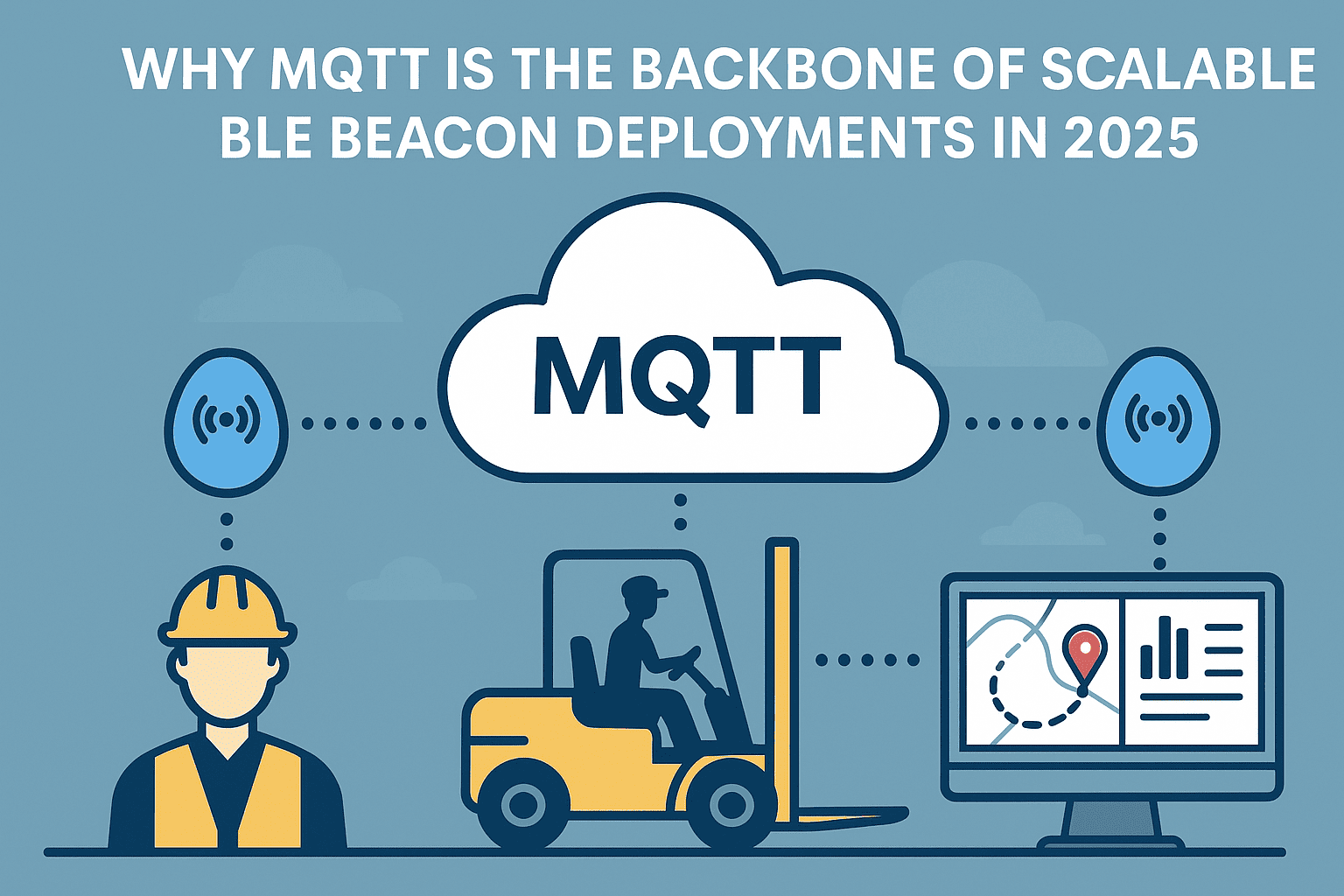
Introduction: Scaling BLE Asset Tracking with MQTT in 2026
BLE MQTT integration connects Bluetooth Low Energy tracking devices with dashboards, alerts, and operational reports. BLE tags help monitor forklifts, carts, equipment, and worker zones. However, collecting signals is only the beginning. The real challenge is delivering useful tracking data as device numbers, locations, and reporting requirements grow.
In 2026, businesses planning real-time indoor asset tracking need reliable messaging, secure connectivity, and practical outage recovery. MQTT, a lightweight publish-subscribe protocol, provides a messaging layer between BLE gateways and connected applications. As a result, tracking data can support manufacturing, healthcare, and warehouse operations.
MQTT Explained: A Lightweight Protocol for BLE Tracking
MQTT is an OASIS-standard messaging protocol designed for connected devices and networks with limited resources. For BLE asset tracking, its role is straightforward:
- It provides a lightweight messaging transport for gateway updates.
- It uses a publish-subscribe model to distribute messages through a broker.
- It delivers published data to applications subscribed to matching topics.
Think of MQTT as a distribution hub. A gateway publishes an update, and the broker forwards it to interested subscribers. Consequently, dashboards and alert services can receive the same information without requiring separate gateway integrations.
Why BLE MQTT Integration Works for Indoor Asset Tracking
BLE tags broadcast identifiers and, depending on their hardware, sensor information. Gateways detect these broadcasts and forward observations for processing. MQTT integration helps distribute those observations or processed tracking events to business applications.
Why BLE and MQTT Work Well Together:
- BLE provides wireless tag observations for proximity or positioning.
- MQTT distributes gateway messages to subscribed systems.
- Low-power BLE tags and lightweight MQTT messaging serve different efficiency needs.
- Together, they can support large tracking deployments when infrastructure is sized and tested appropriately.
For example, a factory tracking 1,000 assets needs more than device connectivity. Gateway coverage, update frequency, broker capacity, and application processing determine performance. Moreover, location accuracy depends on the BLE positioning method and environment, rather than MQTT itself.
BLE MQTT Architecture: From Tracking Tags to Dashboards
A typical BLE MQTT tracking architecture includes four connected layers:
- BLE tags broadcast identifiers and supported sensor readings from tools, trolleys, equipment, or vehicles.
- BLE gateways capture observations. Gateway software or a separate positioning engine estimates location and movement.
- MQTT broker routes published messages using topics such as site, zone, or asset identifier.
- Dashboards or apps consume updates, store records, and apply rules for reports and notifications.
MQTT vs HTTP, REST, and WebSockets for BLE Tracking
HTTP APIs and WebSockets can also support tracking systems. However, the best choice depends on update frequency, connectivity, and application requirements. MQTT is particularly useful for continuous telemetry distributed to multiple subscribers.
- REST APIs suit configuration, queries, and integrations. Repeated polling for fresh data can add traffic and delay.
- HTTP can efficiently handle batched uploads, although request-response messaging may require additional application logic for continuous updates.
- WebSockets support live bidirectional communication, but delivery acknowledgements and offline queues usually need application-level implementation.
MQTT provides messaging features such as Quality of Service (QoS) and persistent sessions. Nevertheless, dependable delivery requires suitable configuration. A practical deployment may combine MQTT telemetry with REST APIs and browser-facing WebSocket connections.
BLE MQTT Applications in Manufacturing and Healthcare
The following examples show how BLE MQTT integration can connect tracking observations with operational workflows.
BLE MQTT Tracking in a Factory:
- Gateways detect tagged forklifts and publish observations or processed zone updates.
- When the application identifies a restricted-zone event, its rules engine generates a notification.
- The system records the event, notifies a supervisor, and updates the dashboard.
BLE MQTT Asset Tracking in a Hospital:
- Tagged infusion pumps, beds, and other equipment provide observations to nearby gateways.
- Application rules can notify staff when equipment remains idle or has not been detected within a configured period.
- Timestamped records help teams review equipment movement, subject to coverage and reporting intervals.
These workflows turn tracking observations into actionable operational information. However, MQTT transports messages; the application determines what those messages mean and which actions to trigger.
MQTT and Edge Computing for Resilient BLE Tracking
Factories, warehouses, and remote sites can experience unreliable internet connectivity. Therefore, a BLE tracking system should define how local monitoring and queued updates behave during an outage.
A local MQTT broker and edge application can keep on-site workflows running while the cloud connection is unavailable. In addition, gateways can use durable buffering and retry logic to forward stored updates after reconnection. Recovery depends on storage capacity, power availability, and configuration.
Benefits of Edge-Enabled BLE MQTT Integration:
- Local alerts can continue while the internet connection is unavailable.
- Buffered updates can reduce data loss when durable storage and recovery are implemented.
- Local processing can reduce cloud round trips for time-sensitive operational events.
Securing BLE MQTT Tracking Systems in 2026
Asset locations and worker-zone records can reveal sensitive operational information. Therefore, MQTT security requires deliberate configuration across gateways, brokers, applications, and stored data. Encryption is not automatically enabled simply by using MQTT.
MQTT Deployments Can Use:
- TLS encryption to protect gateway-to-broker and application-to-broker connections.
- Client authentication using supported credentials or certificates to verify connecting devices and services.
- Topic-based access controls configured in the broker to restrict publishing and subscription permissions.

How MQTT Helps BLE Asset Tracking Scale
BLE MQTT integration separates tracking data collection from the applications that consume it. This makes it easier to connect additional dashboards, reporting services, and workflow tools as business requirements expand.
For a 2026 deployment, prioritise measured latency, outage recovery, and access control. Validate the complete system under realistic device volumes instead of assuming that the messaging protocol alone guarantees accuracy, availability, or scale.
Key Takeaways for BLE Tracking Decision-Makers
- BLE MQTT integration connects wireless tracking observations with operational applications.
- Choose MQTT, HTTP APIs, or WebSockets according to each integration’s requirements.
- Use edge processing and durable buffering where cloud connectivity is unreliable.
- Configure encryption, authentication, and broker permissions explicitly.
- Tracking data can feed analytics and AI applications, but useful results depend on data quality and application design.
Plan Your BLE MQTT Integration with QTrace
Discuss your BLE asset tracking requirements with QTrace, including site coverage, asset types, update intervals, and dashboard integrations for manufacturing, healthcare, or logistics.
Start with a site assessment and pilot deployment. Then evaluate indoor visibility, message delivery, and operational workflows before expanding the system across your facility.

