
A smart pallet tracking system helps manufacturers and warehouse teams monitor pallets carrying raw materials, work-in-progress items, and finished goods. However, when location records depend only on manual logs, barcode scans, or RFID checkpoints, teams can lose visibility between recorded movements. As a result, misplaced pallets and delayed searches can disrupt production, picking, and dispatch.
What if you could monitor pallet movements automatically indoors, identify their latest detected zone, and receive alerts when materials remain idle beyond an agreed threshold?
A BLE (Bluetooth Low Energy) beacon-based smart pallet tracking system makes this possible using pallet tags, fixed receivers, and tracking software. In addition, useful topics for 2026 planning include zone-level visibility, edge processing, WMS integration, and AI-assisted operational queries. This article explains the architecture, practical applications, benefits, and deployment considerations without assuming every BLE system provides exact coordinates or built-in AI.
Why Traditional Pallet Tracking Falls Short
- Barcode or QR code scans record movements when staff scan each pallet, so missed scans create gaps.
- RFID gate scans capture movements at configured checkpoints, but may not show the pallet’s location between them.
- Manual spreadsheet tracking depends on timely updates and can become disconnected from actual floor activity.
These methods remain useful for identification and transaction control. However, checkpoint-only tracking can leave zone-level visibility gaps. Therefore, BLE tracking can complement existing barcode and RFID workflows by adding automated observations between process steps.
Why GPS Doesn’t Work Reliably Indoors
- Signal Blockage: Roofs, concrete walls, and metal structures can weaken or block satellite signals.
- Unreliable Positioning: Indoor GPS may provide inaccurate positions or no usable fix; there is no universal indoor error range.
- Power Requirements: Frequent location updates can increase tag power demand, although battery performance depends on the device and configuration.
- Limited Zone Visibility: GPS alone is generally unsuitable for distinguishing warehouse work cells or storage zones reliably.
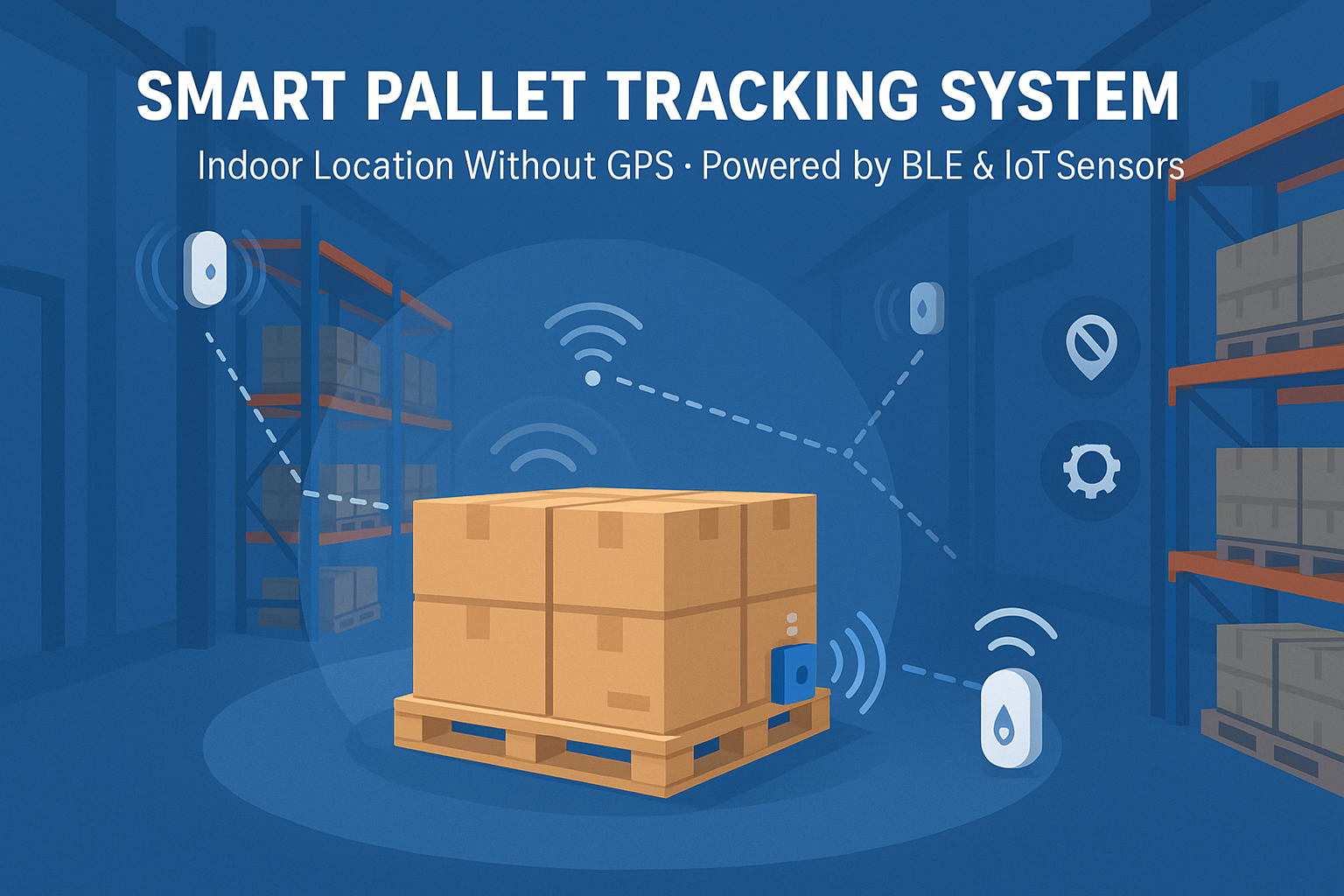
What Is a Smart Pallet Tracking System Using BLE?
A BLE-powered pallet tracking system uses small Bluetooth tags attached to pallets. Each tag broadcasts an identifier that nearby receivers detect. Next, the software associates these observations with a registered pallet and estimates its zone or position. For example, standard signal-strength-based systems support proximity or zone detection; compatible Bluetooth Direction Finding systems use additional hardware for higher-precision positioning. Therefore, accuracy must be validated in the actual facility.
- Identify the latest detected zone and display when the pallet was last seen. As a result, staff can begin searching in the most relevant area.
- Log movement history to review transfers between receiving, production, storage, and dispatch. In addition, these records help teams investigate delays.
- Measure dwell time to identify pallets waiting longer than expected. Consequently, supervisors can prioritize materials that need attention.
- Trigger configurable alerts for unexpected zones, extended inactivity, or missing observations.
- Share tracking data with a central dashboard and connected business applications.
Key Components of the BLE Smart Pallet Tracking Stack
- BLE Beacons (Tags): Durable tags linked to pallet IDs. First, select the enclosure, mounting method, and battery capacity for the operating environment; battery life depends on advertising frequency, temperature, and usage.
- BLE Gateways or Edge Devices: Fixed receivers collect tag observations. In addition, depending on implementation, edge software can filter duplicate readings, buffer events, and forward data over Ethernet, cellular, or Wi-Fi.
- MQTT Protocol: An optional lightweight publish/subscribe transport for gateway-to-platform messaging. The OASIS MQTT standard defines messaging behavior; location calculations are handled separately by the tracking application.
- Central Dashboard and Location Engine: Convert observations into location estimates, movement records, alerts, and reports. Furthermore, AI analytics can be added when supported by the chosen platform.
- Optional Mobile App: Enable authorized staff to search pallet IDs, review last-seen information, and access zone maps from the warehouse floor.
Real-World Manufacturing Use Cases

- Inbound Material Tracking: Record pallet arrival and detected transfers from unloading to inspection and approved storage.
- WIP Tracking: Monitor material movement between production stages and flag excessive waiting times.
- Inventory Zoning: Detect pallets in unexpected areas and support location checks against WMS records.
- Outbound Logistics: Check whether registered order pallets have reached the dispatch zone; confirm shipment details through integrated workflows.
- Returnable Packaging: Monitor reusable pallets and containers within covered areas, and reconcile returns with recorded transactions.
Benefits for Different Stakeholders
- Operations Managers: Review movement patterns, investigate bottlenecks, and prioritize delayed materials.
- Warehouse Staff: Find pallets using recent zone observations and reduce repetitive location logging.
- IT & Integrators: Connect tracking events with WMS, ERP, or MES applications through supported APIs and messaging interfaces.
- Finance & Procurement: Compare search costs, pallet losses, return cycles, and maintenance expenses to assess asset utilization.
AI & Natural Language Dashboard Queries
When an AI-enabled warehouse dashboard is integrated with structured tracking records, users can ask operational questions in everyday language. However, answers should reflect authorized data, last-seen timestamps, and location confidence. Alert creation also requires a supported workflow. For example, possible queries include:
- “Which zone was pallet 48327 last detected in, and when?”
- “Which pallets have no recorded movement in the last 6 hours?”
- “Show pallets currently detected in the packing zone.”
- “List recorded movements for pallets linked to order #9083.”
- “Create an alert when a registered pallet is detected in restricted Zone F.”
Business Impact and ROI
- Reduced Search Time: First, compare average pallet retrieval time before and after a pilot instead of assuming a fixed percentage improvement.
- Improved Material Flow: Next, measure queue time, transfer delays, and pallets waiting beyond process thresholds.
- Less Manual Location Logging: In addition, automate observations while retaining required checks for pallet contents, quantity, and shipment confirmation.
- Better Dispatch Visibility: Similarly, monitor staging readiness and investigate missing pallets before loading begins.
- Support for Inventory Policies: Finally, combine location events with receipt dates, batch records, and expiry data to support FIFO or FEFO workflows.
Why This System Is Future-Ready
- No GPS Required for Indoor Detection: BLE handles the tag-to-receiver link. However, gateways still need suitable connectivity to share data, so a Wi-Fi-free deployment requires another network option.
- Edge Analytics and AI Integration: Local processing can support event filtering and buffering, while connected analytics can help investigate delays.
- WMS, ERP, and MES Connectivity: Link pallet IDs with orders and process records through available integrations rather than maintaining isolated location data.
- Maintainable Hardware: Track battery condition, gateway availability, and damaged tags. Therefore, validate service intervals through a pilot.
- Scalable Deployment Planning: Expand zone by zone after testing receiver coverage, update intervals, event capacity, access controls, and integration performance.
Top Keywords & Searchable Phrases
- Smart pallet tracking system
- BLE pallet location monitoring
- Indoor pallet tracking without GPS
- Real-time pallet tracking in warehouses
- BLE zone tracking vs precise positioning
- Industrial asset tracking with Bluetooth
- AI-assisted warehouse tracking dashboard
- MQTT pallet tracking architecture
- Smart warehouse dwell-time analytics
- WMS-integrated pallet tracking for factories
Conclusion
A smart pallet tracking system using BLE can give manufacturers and warehouse operators better visibility into indoor material movement. By combining automated observations with dwell-time monitoring, configurable alerts, and business-system integration, teams can reduce tracking gaps and make faster operational decisions.
First, start with a defined pilot area and measurable targets. Then validate zone accuracy, data freshness, battery performance, and workflow integration before expanding. Ultimately, whether you manage hundreds or thousands of pallets, the right design depends on facility conditions and the decisions your team needs to make.
Want to Deploy a Smart Pallet Tracking System?
Contact QTrace to discuss your indoor pallet tracking requirements, facility layout, and integration needs. Before proceeding, confirm the proposed location accuracy, network architecture, hardware specifications, and available dashboard features before deployment.
- Email: info@theqtrace.com
- Website: www.theqtrace.com

